
How is AI impacting the Product role?
This report is also available in full as a Google Doc.
Summary
As with everything in product management, the only way to answer ‘how is AI impacting our roles?’ is with ‘it depends’. AI is not changing product roles in the same way everywhere: the organisation's context determines how it unfolds, but a small set of findings are common across every context. This report draws on qualitative interviews with senior product leaders conducted in September 2026, as research for a career development course with Mind the Product. As this is a small, self-selected sample (n=8; mostly UK and Europe), this should be taken as indicative rather than representative of trends in the wider tech landscape.
Common findings, independent of context:
Curiosity and communication remain the top hiring criteria, and neither is AI-specific.
No one argued for cutting junior roles. Every leader wants to keep investing in them, though the specific mechanism for their development differs.
Judgement is a core skill that is becoming scarcer. AI has removed the writing bottleneck and exposed prioritisation and discernment as the real job.
Leadership, not technology, sets the pace. In almost every context, leaders' own understanding of and stance on AI was the main constraint on adoption.
Findings that depended on context:
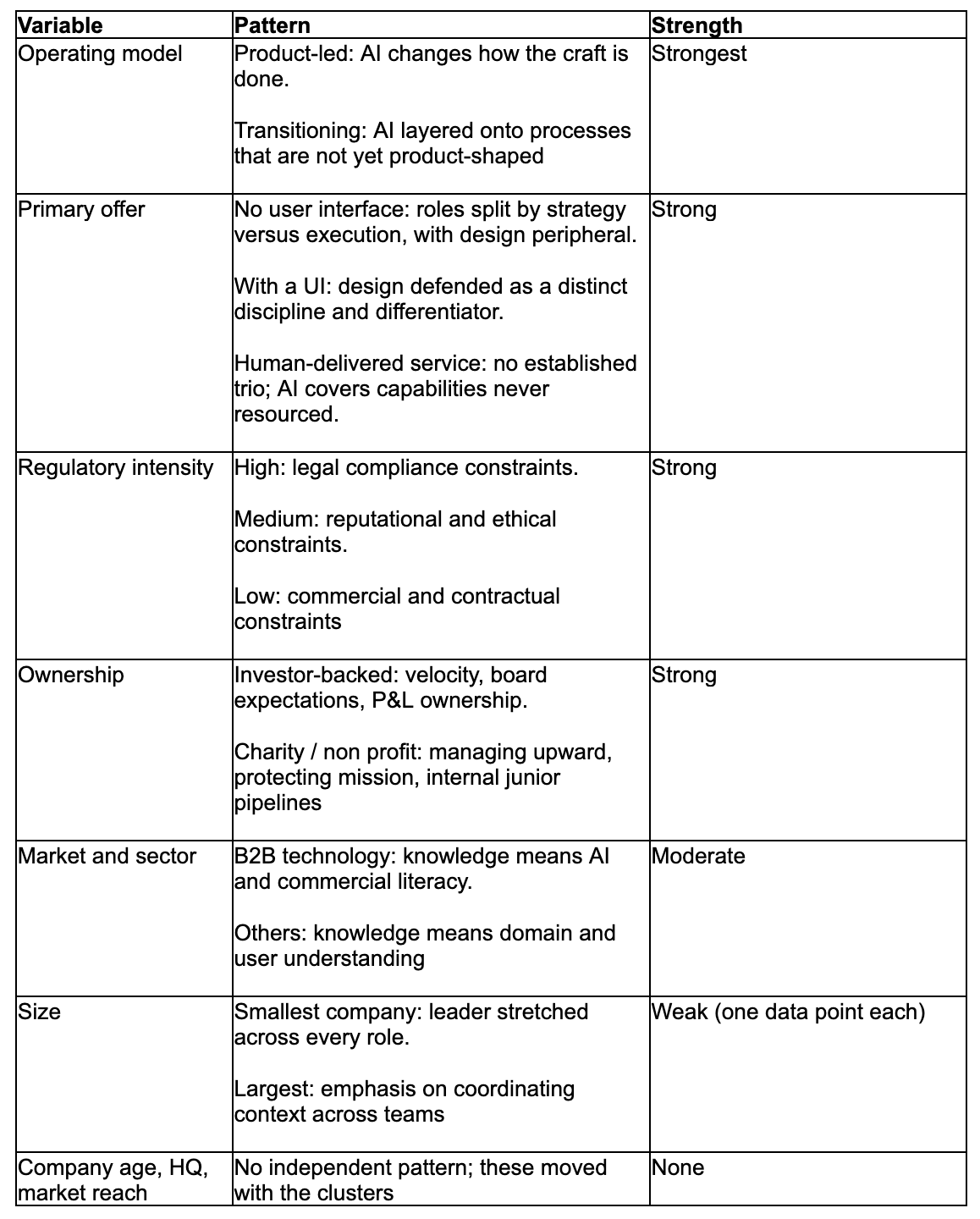
The operating model was the strongest differentiator. In product-led organisations, AI is changing how the craft is done. In organisations still transitioning to product, AI is being layered onto processes that are not yet product-shaped.
The "product builder" model only made sense in a narrow set of conditions: a product-led operating model, where front-end design is not a differentiator, and there are separate engineers owning scale. Elsewhere, it made more sense to maintain separate disciplines for product, design and engineering.
The constraints leaders cite shift with the levels of legal regulation within the industry: legal compliance where it is high, reputational where it is medium, commercial where it is low.
The sample is small and clusters into three organisational profiles with one notable exception, so findings are presented at that level rather than as effects of any single variable.
Method
Interviews
Seven semi-structured interviews were conducted between 14 and 29 September 2026, each lasting on average 45 minutes over video call. One participant (P8) recorded their answers to the same topics asynchronously rather than joining a live call. Participants were CPOs, product directors and heads of product or digital, recruited mainly through the CPO Connect community.
Each conversation opened with a broad question about how AI is affecting product roles in the participant's organisation, before covering a consistent set of topics so responses could be compared:
How role boundaries in the product trio are changing
What knowledge, skills and experience PMs need now
What PMs actually spend their time on
What matters most when hiring
What capabilities product leaders need
How juniors are being developed
How ways of working and operating models are changing
Conversations were transcribed with Granola. Participants are referred to by code (P1 to P8) throughout to protect anonymity.
Context coding
Each participant's organisation was coded against ten context variables, designed so that readers can identify their own organisation and compare. The variables and their categories are listed in the appendix.
Two participants spoke about more than one organisation. P3 had been in their current role for two weeks, so their responses are coded to their previous employer, which most of their examples drew on. P4 moved between their current contract, a previous employer and hypothetical scenarios, so their responses are coded to their current organisation.
Analysis
Analysis was iterative. Each transcript was processed with AI shortly after the interview, and emerging patterns informed the focus of later conversations. Once all eight interviews were complete, responses were summarised against each topic and compared across context variables in a Framework Analysis. Findings that appeared regardless of context are reported as constants. Where findings varied, the variable that best explained the difference was identified. Claude was used to support this analysis (see AI use statement).
Limitations
Small sample. Eight interviews support pattern-spotting, not generalisation.
Variables cluster. The three B2B technology companies are also all product-led, low-regulation and headquartered in mainland Europe. Their effects cannot be separated.
Gaps in coverage. There is no B2C digital product company (such as a consumer app, marketplace or fintech), and only one organisation headquartered outside the UK and Europe, with none in North America. This is a significant limitation as companies based in the US, particularly Silicon Valley startups, are innovating on the product role and operating model.
Self-selection. Participants volunteered, so they are likely to be more engaged with AI and this particular topic.
Common findings, independent of context
Four findings appeared across organisational contexts.
1. Hiring still starts with human qualities
Curiosity was named as the top hiring criterion, unprompted, in nearly every interview. Communication and relationship-building came close behind. One CPO described their three hiring criteria as communication, relationship-building and raw intellectual curiosity, and noted that none had changed because of AI.
AI experience features as a signal of curiosity rather than a requirement in itself. Leaders look for people who have built something in their own time or can explain how AI shaped their thinking. Along with curiosity, an openness to learn was cited as important, as several of the participants felt that AI skills can be taught if the individual is open and willing to learn.
P8 noted that past experience is becoming a weaker signal, because how people worked before differs from how they will work in future. They favour whiteboarding and pairing exercises over case studies, which they consider 'almost certainly dead'.
2. Keep investing in juniors
No product leader argued for reducing junior roles, despite the public narrative that AI is removing graduate jobs. Several argued the opposite: that AI lets less experienced people produce high-quality work quickly, if they have the right guardrails.
The concern is judgement, not skills. Juniors can now generate polished output but may lack the experience to spot when it is wrong. Leaders described different ways of building that judgement:
Fundamentals first. P2 asks juniors to write problem statements and value propositions without AI before using it.
Guardrails. P3 and P4 argue for hiring more graduates, not fewer, with templates and evaluation criteria to assure quality.
Access to experience. P1 encourages juniors to frequently check in with seniors, who can pass on years of context in a few minutes.
Internal pipelines. P6 and P7 develop people from operational roles who already understand the business, into product managers.
Presence. P8 argues leaders should spend time embedded in junior PMs' teams, attending planning and refinement sessions, because juniors no longer learn by working alongside experienced colleagues in an office.
P8 also raised a responsibility beyond the organisation. Schools and universities are not keeping pace with the workplace, so product leaders should engage with students before they enter the workforce.
3. Judgement is the scarce skill
AI has removed much of the writing burden. Across every context, PMs are spending less time drafting PRDs, user stories, requirements and summaries, and more time reviewing and editing AI output, prototyping, and talking to customers and stakeholders. What remains exposed is the core of the role: deciding what matters. As one participant put it, AI is bad at saying no. Ask for 10 ideas and you get 10, then 20 more.
Participants described this as the same skill product has always needed, made harder by the volume of noise and the speed of building. Several warned of what happens when judgement slips: shipping faster than customers can absorb, with outcomes forgotten. As P3 noted, slow delivery used to force discipline about what was worth building. With that constraint gone, the discipline has to come from people.
Several participants described a related shift: the bottleneck has moved from building to context. AI output is only as good as the information it is given, so capturing, organising and sharing context is becoming core product work. P4 encourages teams to record conversations and let AI synthesise them, rather than writing documents from scratch. P5 warned that individuals building their own AI tools creates silos and unreliable data, and that teams need to work from shared sources.
P8 described a 'librarian agent' approach: documenting every meeting and decision in a machine-readable file structure so agents can retrieve the right context next time. They also expect PMs to understand agent harnesses and build their own, which sits in tension with P5's concern about silos.
4. Leadership sets the pace
In seven of eight interviews, participants described leadership, rather than technology, as the main constraint on AI adoption. The form varies with context, but the pattern does not.
Holding back. P1 described CPOs avoiding AI because it threatens the expertise their careers were built on. P4 found executives treating operating model change as too hard for this year, so deferred it until next – a repeating pattern. P6's CEO has not set an AI policy in 18 months.
Pushing without a strategy. P3 described Copilot rollouts driven by fear of missing out, even though the business case appeared weak. P7 described executives feeding data into AI tools and making decisions from the resulting dashboards without quality assurance on that data.
Expected to have answers no one has yet. P1 and P3 both described pressure from boards and CEOs to know how to apply AI, while everyone is still working it out.
Participants described what helps: leaders who model their own use of AI (P2), who have enough technical and commercial understanding to set guardrails (P5), and who have the humility to say "teach me" to their teams (P1).
Findings dependent on context
Seven of the eight organisations fall into three profiles. The eighth is an exception, covered below. If you are reading this to understand your own situation, start by finding the profile closest to yours.
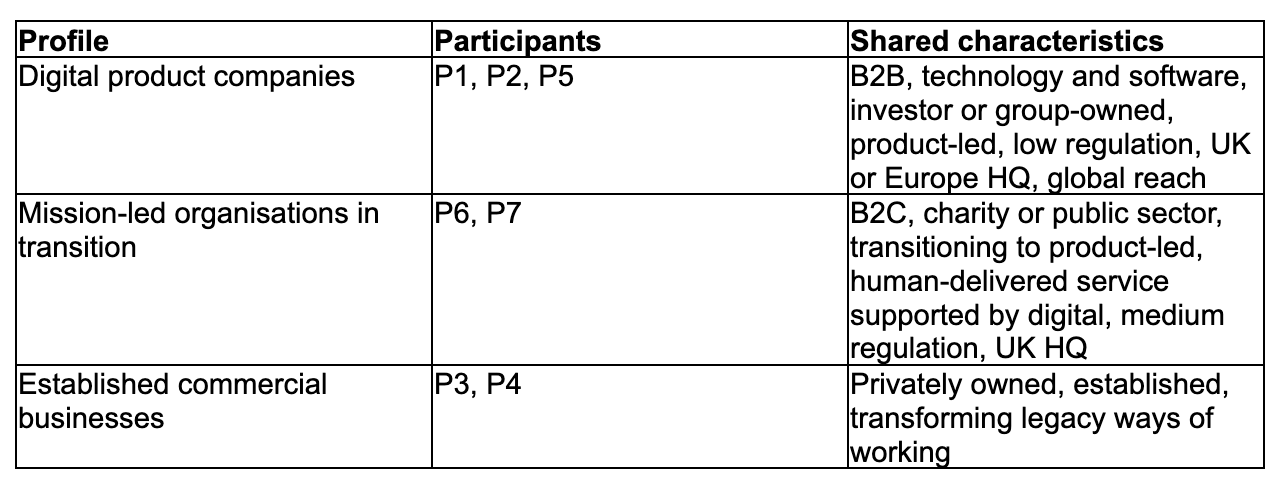
1. Digital product companies
Here, AI is changing how the craft of product is done. Leaders talked about AI skills that write PRDs in the team's format, evaluation criteria (evals) to test AI output, rapid prototyping, and capturing context through recorded conversations.
Role boundaries: the liveliest debate. P2 has moved from a trio to a duo (see ‘product builder’ section below), while P5 strongly defends the trio, arguing that debate between three perspectives is where good product comes from.
Knowledge: defined as AI and commercial literacy: model costs, pricing, positioning, build versus buy.
Leadership: technical and commercial fluency, so leaders can set guardrails and delegate. As P5 put it, you cannot delegate what you do not understand.
2. Mission-led organisations in transition
Here, AI has arrived before the product operating model is fully in place. The questions are less about craft and more about organisational readiness.
Role boundaries: neither organisation has a traditional trio, so the question is not whether roles are compressing. Instead, AI is covering capabilities these organisations never resourced. At P7's organisation, Claude-generated prototypes are used in place of UX design. At P6's, a channels manager who vibe-codes has enabled small cross-functional squads for innovation work.
Knowledge: defined as domain and ethical knowledge: the sector, the user, data rights, and what is acceptable given the organisation's mission. Knowing that your customers are pro- or anti-AI is critical to success in how it is implemented within the product, and making the wrong decision can negatively impact organisational reputation.
Leadership: managing upward. P6 has called for an AI policy for 18 months without one. P7 describes executive enthusiasm as haphazard, raising data governance concerns.
Juniors: both organisations develop product people through internal routes from operational roles with substantial business knowledge. No commercial organisation described this.
3. Established commercial businesses
Here, the tension is between AI ambition and legacy structures. Both participants described AI being layered onto existing processes rather than used to rethink them from first principles.
Operating model: P4 argues that quarterly planning and sprint ceremonies were designed for slow, expensive software and now create bottlenecks. P3 describes Copilot rollouts driven by fear of missing out, with modest efficiency gains of 5 to 10%.
Governance: in regulated settings, individually built AI agents are restricted from being shared until governance catches up, creating duplication and key-person risk.
Leadership: bridging the gap between teams who want to adopt AI and executives who are hesitant or pushing without a strategy.
An exception: transitioning, but working like a product-led organisation
P8's organisation is transitioning to a product-led model, yet their account reads like the digital product companies. Rather than compressing roles, AI is tightening the interface between product and engineering. P8 felt PMs had become lax with requirements, "throwing stuff over the fence". Their team now uses a proposal as the unit of work in place of a PRD, which engineering turns into a technical specification, with LLMs identifying conflicts between the two. This suggests the operating model predicts how AI is used, but not deterministically: individual leaders can bring product-led practices into organisations still in transition.
4. When does the product builder model make sense?
The "product builder", one person who takes an idea from discovery to production, is widely discussed. In this research it appeared in only one organisation, and only under specific conditions.
P2's organisation has replaced the traditional trio with a duo. A strategic PM owns the P&L, customer context and narrative, moving closer to a general manager with responsibility for positioning and messaging also. A product engineer owns execution end to end: building prototypes, running discovery calls and shipping.
Three conditions made this work:
Little or no user interface. As a data platform, design is not a core differentiator, so it can be outsourced.
A product-led operating model already in place, with a clear line between strategy and execution.
Separate software engineers who own scalability, security and reliability, taking prototypes into production.
Even here, a sole product builder was not the goal. P2 noted that people who can do everything are very hard to find, which is why builders are paired with a strategic PM.
Company stage may also matter. P2's organisation is relatively small (51–200 people). P1 observed that generalists thrive at earlier stages, but specialist depth becomes essential as companies grow, which suggests the model may not survive scaling.
Elsewhere, leaders were sceptical. P5 argued that merging three disciplines into one person risks bias, overload and inconsistent user experiences. They also noted that AI-generated prototypes tend to look the same, which makes design more of a differentiator, not less. P7 observed that people who blend disciplines have always existed, often moving into combined product and technology leadership roles (e.g. CPTO).
Patterns by context variable
Four variables showed a clear relationship with how participants answered, and one a moderate relationship. The rest moved with the clusters above and showed nothing independent.
What this means
The most useful question is not "how is AI changing Product?" but "how is AI changing Product here?" Advice drawn from AI-native companies may not transfer to an organisation still moving to a product operating model.
For product managers
Invest in the constants. Curiosity, communication and judgement are valued everywhere. They are also the skills most at risk if AI does your thinking for you.
Know your context. Use the profiles above to judge which advice applies to you. A heritage charity and a venture-backed data platform need different things from their PMs.
Build judgement deliberately. One leader asks juniors to do core work without AI first, so they learn what good looks like before they direct AI to produce it.
For product leaders
Resist copying the loudest examples. Structures built for AI-native, B2B technology companies may not suit your operating model, offer or regulatory context.
Keep hiring juniors, with guardrails. Every leader interviewed saw value in junior talent. The difference is in how they protect quality (judgement) while that talent develops.
Close your own knowledge gaps. Leaders in product-led organisations stressed technical and commercial AI fluency. Leaders in transitioning organisations emphasised the ability to shape policy and manage upward.
Researcher’s reflexivity statement
In qualitative research, the researcher shapes what is asked, heard and interpreted. These are the positions and assumptions I brought to this work, so readers can weigh the findings accordingly.
My position
I spent 13 years in product management, five of them at product director level. My most recent in-house role was as interim head of product at a heritage financial services company, ending in 2024. Generative AI was emerging during that period, but it was not yet embedded in product teams' day-to-day work in the way participants now describe. I approached these interviews partly as an insider who knows the role well, and partly as an outsider to how AI is now changing it day to day.
I am now a leadership coach. I have studied leadership at Oxford University and from September 2026 I have started studying for my MSc in Organisational Psychology at Birkbeck. I think in systems and look for (social) psychological and organisational explanations. That lens may have drawn my attention to leadership, culture and judgement over tooling and technical detail.
Assumptions I brought
Human skills matter. My starting hypothesis for the research was that career resilience rests on human skills rather than tool knowledge. Several findings support this, and I have tried not to over-read them because they confirm what I expected.
The trio is valuable. I believe cognitive diversity produces better products. I shared this view during some interviews, which may have encouraged agreement.
Scepticism of hype. I set out to balance the AI-native narrative with other perspectives. This may have made me more receptive to accounts of slower, messier adoption.
How I may have influenced responses
Sharing earlier findings. In later interviews I sometimes described what previous participants had said, such as the move from trio to duo. This may have framed how later participants responded.
Existing relationships. Several participants know me through my network. One is a current coaching client, and I have offered informal support to others. These relationships may have made participants more open, or more inclined to tell me what they thought I wanted to hear (social desirability bias).
Commercial interest. This research feeds a course I am developing with Mind the Product, and my own business serves product leaders. I have a stake in the findings being useful and relevant.
Who was heard
The first people to volunteer were all men. I actively sought out women's perspectives, and the final sample includes three women out of eight. Six participants are UK-based and two are based in Europe. One UK-based participant works for an organisation headquartered in Africa. Their views reflect that context.
AI use statement
AI tools were used at several stages of this research. As each interview was conducted, the transcript was processed with AI to identify emerging patterns that informed later stages of the research. The researcher conducted every interview, made the analytical decisions and checked all AI-generated content against the original transcripts.
Tools used
Granola transcribed each interview. Calls were not video recorded.
Claude (Anthropic, Claude Opus 5.5) supported analysis and drafting.
Safeguards and limitations
AI can misattribute quotes, overstate patterns and invent details. To reduce this risk, summaries were checked against the transcripts and verified that each response was attributed to the correct participant and was accurate.
Claude's pattern analysis was also shaped by the researcher’s prompts, including the view that organisational context was the root of the variation. Another researcher using the same data and tools might have reached different conclusions.
Transcripts were processed in Claude under the researcher’s own account. Participants gave consent for their interviews to be transcribed and synthesised with AI.
Next steps
The findings in this report point to three things product organisations need now: sharper judgement in their teams, leaders who can set the pace on AI, and people resilient enough to keep adapting as roles change.
Caroline Clark works with product leaders and their organisations on exactly these challenges, drawing on 13 years in product leadership and training in organisational psychology.
Executive coaching for product leaders navigating role change, AI adoption and the step up into senior leadership.
Organisational development advice for leadership teams deciding how product roles, operating models and AI policy should evolve in their own context.
Workshops for product teams, including:
Developing product sense: building the judgement to decide what matters when AI can generate almost anything.
Building resilience: helping teams adapt to fast-moving change without burning out. This workshop was one of the most highly rated sessions at Mind the Product's 2026 conference.
To discuss what would help your team, get in touch.
Email: caroline@expansum.space
Website: https://expansum.space
Book a discovery call: https://calendly.com/carolineclarkspace/discovery
Updated September 2026